What a flooded bus could tell you
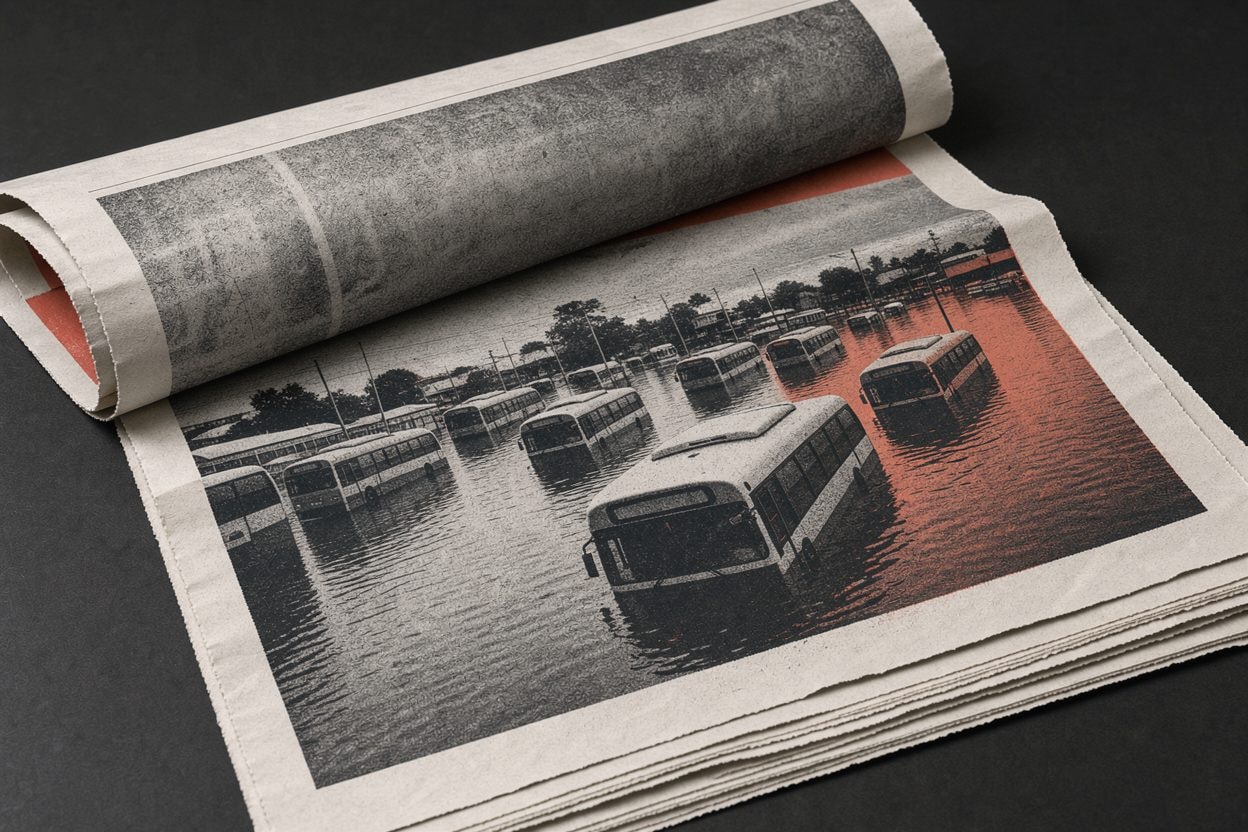
Pictures of school buses standing in floodwater became an argument about Hurricane Katrina. The column asked what had to happen before any one of those buses could move.
Reading past the photograph
A full bus needs a driver, fuel, a safe route, a place to stop and somewhere for its passengers to stay. The column credited Have Coffee, Will Write for a calculation that considered the road to Houston, the time needed to load passengers and the number of trips that could be made. It challenged the idea that the photograph by itself settled who had failed to evacuate New Orleans.
Other entries asked what had happened to the federal response and where National Guard resources had been sent. The editor wanted a public accounting of decisions made before the levees failed as well as decisions made afterward. He objected to the suggestion that to ask those questions was merely to assign blame.
A family in Mississippi
A correspondent went to help family in Diamondhead and described picking small religious objects out of the wreckage. Another message listed the ordinary supplies people needed. Together they gave the story a geography beyond New Orleans. The family account offered something the bus photograph could never contain. The Gulf Coast letters
Another hurricane, another march
As Rita approached, television showed roads filling with people trying to leave the coast. Blumrich compared the coverage with the judgment passed on people who had been unable to leave before Katrina. Religion, race and class all entered the argument about whose decision was called prudent.
The column also followed the antiwar march in Washington. The editor traveled to it, posted photographs and took up the way the press represented the crowds. Iraq kept returning to the page even during the weeks when almost every headline concerned a domestic disaster.
Subjects in this issue
- Katrina response
- The column compared the sequence of declarations, requests for help and federal action. A page of timelines gave readers several levels of detail.
- The bus photograph
- Have Coffee, Will Write supplied a model using loading times, road distances, passenger places and the return journey. Each assumption changed the answer to the question the picture appeared to settle.
- Letters from the coast
- A firsthand account from Mississippi accompanied a list of needs and a reprinted open letter from the New Orleans Times-Picayune.
- A microphone in Union Square
- Cindy Sheehan’s appearance brought the writer back to New York. The dispute concerned a public-address system in a small park already crowded with the noise of city traffic.
- Washington and Iraq
- Antiwar march photographs and a counterprotest newspaper headline became an argument about what readers saw first. Other entries kept track of Iraq while hurricane coverage dominated the news.
A newspaper over lunch
Back from the Washington march, Blumrich found that his local paper had run a wire report about the counterprotest. The headline and the crowd estimate below are reported in his words.
First off- once again, screw the corporate media- during my lunch break, today, I picked up a copy of the NJ Star Ledger to read over my egg rolls and hot and sour soup, and looked for any articles relating the the march on Washington- I turned to page three, and there it was, direct from the AP:
HUNDREDS MARCH TO SUPPORT TROOPS IN DC
Now- before you get all riled up about the low figure cited- the article was all about the pro-war freeper counter-protest, giving only a few sentences of mention to the hundreds of thousands who were ALSO marching "to support our troops." The article neglected to mention that these sad, sick bastards "supported the troops", by supporting a war that has long since turned into a meatgrinder for both Iraqis and Americans, whereas we felt the best way to support the troops was to ensure that this unconsitutional, immoral war is brought to an end, as soon as possible.
Is there any paper that doesn't use the AP as a wire source? I feel a boycott brewing within me...
Elsewhere in the column
The road away from Rita
Blumrich turned on the BBC and saw the outbound traffic as Hurricane Rita approached. He wondered how many of the people leaving the Gulf had already lost a home in the previous hurricane. The numbers and comments on federal assistance reflect his impressions at the time.
When I awoke this morning, I checked out the news on the BBC, and was greeted with quite a sight. […] Add to this, the displaced people from the Katrina disaster which are being moved from their temporary shelters, further inland. I'd not be surprised to learn that over two million are scurrying for cover, at this hour.
The scenes on the freeways leading out of the threatened areas look like a linear superdome, with suffering, gridlock, and people expiring by the roadside. […] federal assistance is slightly more visible.
As one of the few republicans with whom I still maintain a passing acquaintence recently said: "Gee- we humans like to think we can screw things up- but time after time, nature teaches us who the real bastard is"
Four ways to read a timeline
The column offered four accounts of the disaster’s sequence, from a visual overview to longer chronologies assembled online. It listed them by the amount of detail a reader wanted.
TIMELINES
Just like for 9/11 and the Iraq war, sourced timelines are key in cutting through the Bush Administrations efforts to obfuscate the TRUTH. Here are some of the timelines that are beginning to take shape:
Very Brief Visual Timeline
More Detailed ThinkProgress Timeline
Very Detailed Wikipedia Timeline
Very Detailed Dkosopedia Timeline